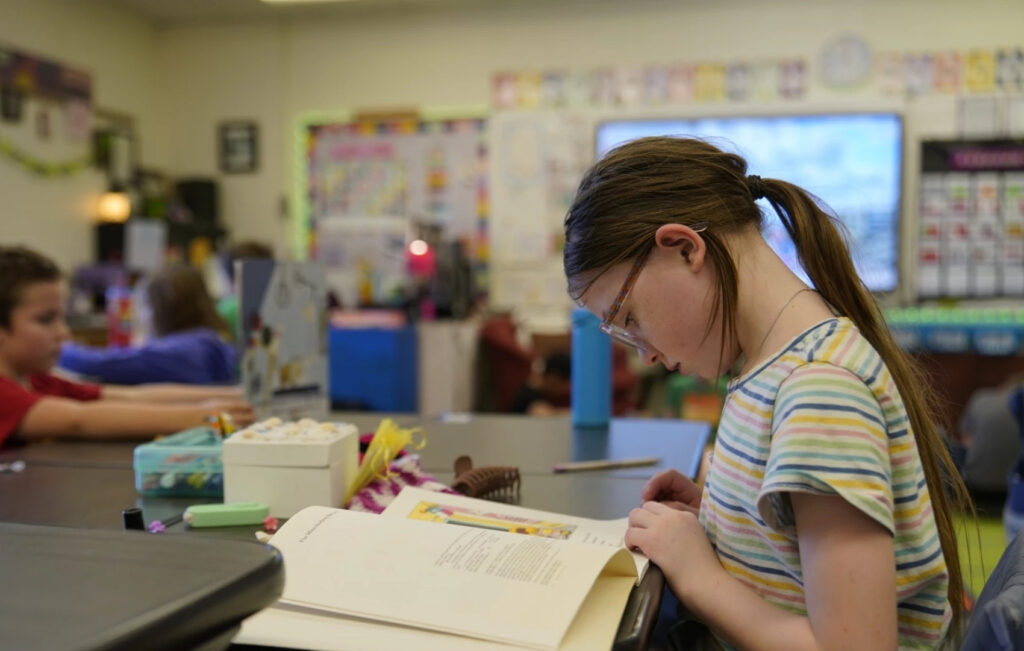

As the rise of artificial intelligence puts technology front and center in most every industry, one Wexford County school district is going analog, stripping elementary students of Chromebooks and iPads and replacing them with paper books.
Last month, Mesick Elementary School rolled out its “no screens literacy initiative” — among the first in the state to do so — in a bid to improve reading scores. Michigan’s kids fall behind most others in reading and writing proficiency, standardized test scores reveal.
“When we’re looking at proficiency test scores of 20%, 30% or 40%, sometimes those kinds of drastically low scores need some drastic measures,” Mesick Superintendent Jack Ledford said. “We basically grounded 250 students and took away their devices.”
Last school year, more than 65% of Mesick’s third-, fourth- and fifth-grade students ranked “partially proficient” or “not proficient” in English Language Arts on state standardized tests, state data shows.
The district’s decision to cut screens, which has attracted the attention of neighboring school districts, reflects a growing body of research linking heavy screen use with lower academic performance, mental health challenges and behavioral issues.
“With districts taking away Chromebooks, it’s a big topic that everyone is thinking about, but not as intentional as what Mesick has done,” said Jamey Fitzpatrick, president and CEO of Michigan Virtual, a nonprofit that provides online courses, digital learning tools and professional development to more than 360 Michigan school districts.
The move comes with risk, researchers say.
“Computer literacy is just a necessity today,” said University of Michigan cognitive neuroscientist Ioulia Kovelman, who studies how children’s brains develop as they learn to read. “We can’t go back to the stone age and ask people to write on stone tablets.”
Under Mesick’s new policy, teachers replace some virtual components of daily instruction with hands-on activities and games. The district has allocated $30,000 toward books and teaching materials for educators.
Screens still are used for testing and when allowed by an individualized education plan for special education students….